
Texas A&M Ocean Engineering has facilities in two locations: College Station and Galveston.
College Station
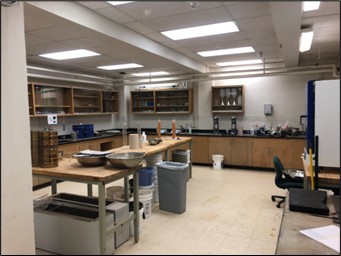
Ocean Engineering has build space for student boat competitions (electric boat, human powered submarine, etc.), class builds (ROVs during their Soph., Junior, and Senior classes), and research. It consists of benchtop space, tools, and storage. There are 3D printing stations, weight, ballast, and measurement equipment, soldering and electronic stations, and a large construction zone.

The Marine Dynamics Laboratory investigates the various problems and issues associated with the nonlinear and stochastic dynamics of ships and floating offshore platforms. The primary focus has been the development of an integrated design environment to simulate the large amplitude motions and stability of both ships and floating offshore platforms.
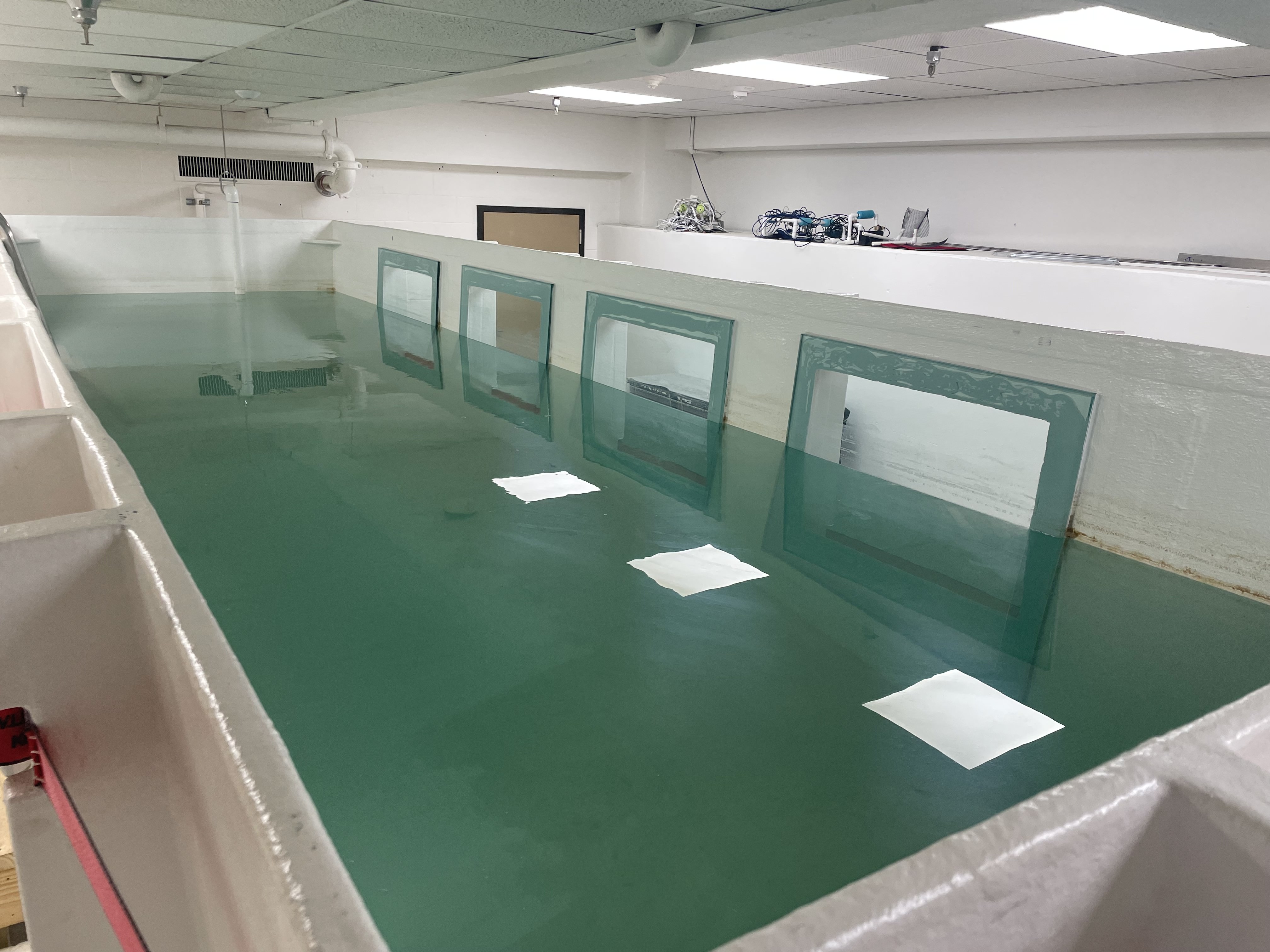
The TAMU Ocean Engineering building houses several facilities that are accessible to students. The ABS Mixed-Reality(MR) ABS Lab employs a motion camera system, headsets with live feeds and is focused on hardware testing and hazard perception testing. The Research Water Tank holds 4700 gallons and is 22’ long x 7’ wide x 4.5’ deep.



Galveston
The Recirculating Water Tunnel (RWT) has a test section that is located above the working platform on the second floor has clear acrylic or polycarbonate walls. Its interior dimensions are 100 cm long by 30 cm wide (by 30 cm high. The mean flow speed in the test section is continuously adjustable from 0.80 m/s to 10.00 m/s, which for full test-section height yields a channel-height-based Reynolds number (Re) up to 3× 10 6 . The test section can be pressurized or evacuated to test cavitations in the flow. This facility is used for various model tests, including the cavitation of underwater vehicles, bio-inspired fish robots, and turbines. It is also capable of measuring turbulent boundary layers and multi-phase flows around a model, The water tunnel is an ideal facility to test tidal turbine blades. Equipped with Particle Image Velocimetry (PIV), it can measure detailed flow fields around the blades. The facility can measure the drag and lift forces acting on the turbine. The facility can match the Reynolds numbers encountered by actual tidal turbines, particularly for areas with high tidal velocities such as the Gulf of Maine.
The Particle Image Velocimetry (PIV) system consists of a high-speed camera (Phantom, VEO 410L), a double pulsed high energy 532 nm Nd: YAG laser (Litron, NANO L 135-15PIV), and DaVis software. The system can measure high-speed flow filed with high accuracy. It is an ideal method in measuring flow filed around tidal turbine models within the water tunnel.
Texas A&M University at Galveston serves as the marine and maritime branch campus of Texas A&M University. Situated in Galveston, Texas, this campus enjoys a strategic location on the Gulf Coast, surrounded by key industries, diverse environmental settings, and programs that are crucial for its ocean-focused mission. The branch campus is equipped with various vessels dedicated to research and educational purposes, including the R/V Trident. This vessel, an all- aluminum 65-foot catamaran, is versatile and can be utilized for a multitude of purposes. For example, the vessel has been used to test current and wave forces on a cylinder at various speeds (see the figure), in the Graduate course (OCEN 615) offered in the Department of Ocean Engineering at TAMU.